

The truck arrives at 4am. An articulated truck, or more likely several of them, pulling into a stadium car park while the city sleeps. By the time a single ticket-holder joins the queue outside, a crew of hundreds has already spent 48 to 72 hours rigging, cabling, testing, and arguing about load weights. The show the audience pays for is, at most, a few hours. The show that makes it possible is days longer and significantly more complex. And behind that show is a planning document that was started, in some cases, 18 months earlier. Aspiring event professionals spend enormous energy studying what makes events feel good. Far fewer have been taught what makes them function. The gap between those two things lives entirely in a set of specific, learnable documents, and understanding those documents is what separates someone who attends events from someone who operates them.
The 18-Month Picture: How Professional Event Planning Actually Starts
Most people, when they imagine event planning, picture a checklist. Something to track tasks and tick off as they go. Professional event producers do use lists, but the planning infrastructure beneath a major event is considerably more structured than that, and it begins far earlier than most aspiring professionals expect.
For large-scale events, the planning horizon typically stretches 18 to 24 months from event date. Venue holds and anchor supplier conversations often begin at that outer edge. In the UK, licensing applications for events involving licensable activities must be submitted to the local authority in compliance with the Licensing Act 2003, with statutory minimum notice periods that shape the planning calendar from the outset. The Purple Guide to Health, Safety and Welfare at Music and Other Events, first published in 1999 and now the authoritative UK framework for live event safety planning, recommends that large outdoor festivals begin engaging with Safety Advisory Groups up to 12 months before the event date. That is not a recommendation about caution. It is a recognition that at scale, there is simply no other way to get everything done in time.
The methodology that makes this manageable is backward planning. Experienced producers anchor the event date first, then work backward to identify every dependency — every task that must be completed before the next one can begin. This is not intuition. It is a discipline with a specific name and a specific history.
The Documents That Run the Event
The Gantt Chart: The Macro View
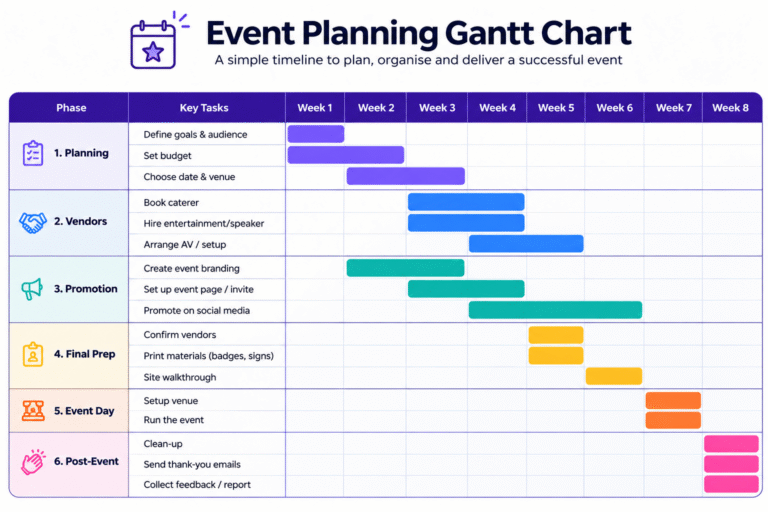
Henry Gantt developed his eponymous chart between approximately 1910 and 1915 as a production management tool for manufacturing. Over a century later, the Project Management Institute identifies it as a standard instrument in event management. The format has barely changed: horizontal bars represent tasks plotted against a timeline, making it immediately visible which activities overlap, which depend on others, and where the schedule has slack.
In event planning, the Gantt chart is the master planning document for the months-out phase. It captures the full project arc, from initial concept and venue confirmation through to supplier briefings, marketing milestones, technical preparation, and pre-event rehearsals. A well-built event Gantt chart can run to dozens of rows, each representing a task stream, with colour-coded dependencies showing exactly which items are blocking others.
What a Gantt chart cannot do is tell you, on the day, what happens at 19:47. For that, you need a different document entirely.
The Critical Path: The Document Whose Failure Delays the Event
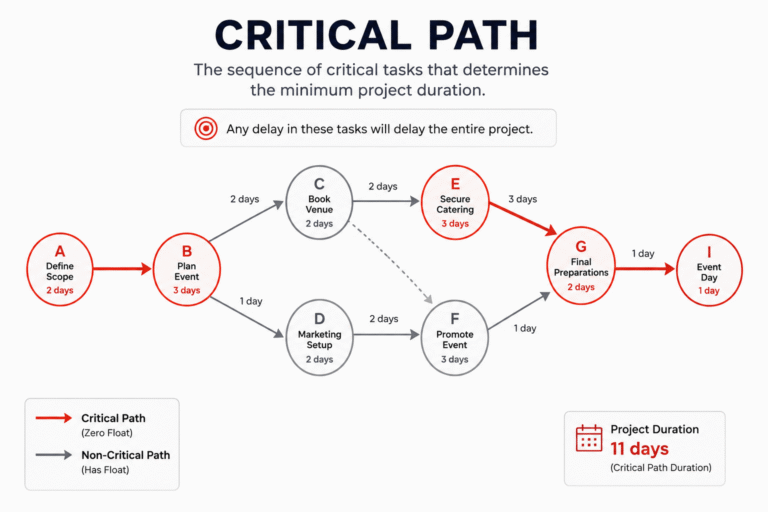
The critical path method was not invented by event planners. It was developed in the late 1950s by DuPont and Remington Rand as a project management methodology for large engineering programmes, and the Project Management Institute now includes it as a standard element of event project management curricula. The fact that it migrated from industrial engineering into live events is not a coincidence. It reflects how genuinely complex large event production has become.
The critical path is a subset of the full project plan. It identifies the specific sequence of tasks where any delay will directly push back the event date. Not every task on a Gantt chart sits on the critical path. Some have float, the planning equivalent of slack in a rope. Others have none. If your venue confirmation is on the critical path and it slips by two weeks, every downstream task slips with it: the licensing application, the contractor briefings, the technical riders, the ticketing launch.
This is the single document most aspiring event professionals have never been taught to read. Understanding it is the most important operational skill at this stage of a career, not because it is glamorous, but because it is the mechanism by which the entire timeline is stress-tested.
The Production Schedule: The Bridge Document
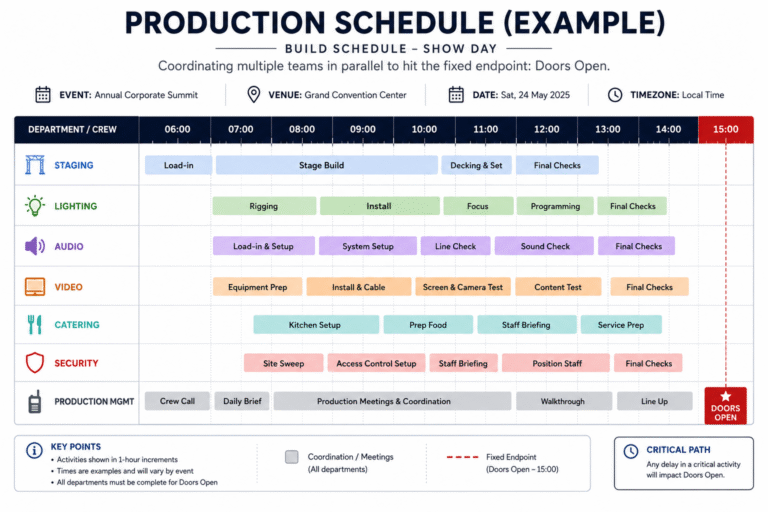
Between the months-level Gantt chart and the minute-by-minute run-of-show sits the production schedule, a document that governs the build phase of an event in granular detail. Technical production schedules for large concerts can run to dozens of pages and specify activity in 15-minute or five-minute increments across load-in and show days.
The production schedule is not a single-department document. It coordinates the simultaneous activity of multiple crews: rigging, lighting, audio, staging, catering, security, broadcast. For televised or streamed events, a separate broadcast timeline runs in parallel, governing camera positions, signal routing, and satellite uplink schedules. All of these must land against the same fixed endpoint: doors open.
The Run-of-Show: The Day’s Operating Document
The run-of-show is frequently misunderstood by aspiring professionals as a more detailed version of the production schedule. It is a different document serving a different function. Where the production schedule governs the build, the run-of-show governs the live event itself.
It is a minute-by-minute schedule of everything that happens from first doors to last exit, stage changeovers, host cues, lighting states, crowd management transitions, broadcast breaks. Every department head carries it simultaneously. The production manager, the stage manager, the floor manager, the lighting director: they are all working from the same document in real time. When a speaker runs long or a changeover takes 90 seconds more than planned, the run-of-show is what everyone uses to recalculate and communicate.
Conflating the run-of-show with the production schedule is a reliable indicator that someone has learned event terminology from the internet rather than from operations. They are distinct artefacts with distinct purposes, and professional contexts expect you to know the difference.
The Sub-Timeline You Never See: Artist Logistics and the Green Room
Here is where the abstraction becomes concrete. The green room, the backstage area where artists rest, prepare, and receive hospitality, is not a casual arrangement. It is a milestone on a dedicated sub-timeline, managed by a production manager and an artist liaison officer, built from the artist’s technical rider weeks or months in advance.
The rider specifies requirements in detail: catering preferences, dressing room layout, security protocols, sound equipment in the warm-up space, specific products, sometimes specific temperatures. Each item has to be sourced, confirmed, and in place before the artist arrives. The security briefing schedule, the soundcheck window, the changeover time between acts on a multi-stage festival, all of these run on a separate sub-timeline that feeds into the master Gantt chart but is managed independently.
This is, in miniature, the operating logic of the entire event. Every department generates its own sub-timeline. Artist logistics, catering, medical, security, broadcast, each has a parallel document stream that the production office coordinates against the master schedule. The ops room at a major event is not a place where people watch things go smoothly. It is where these sub-timelines are actively monitored and adjusted in real time when they deviate.
When the Timeline Breaks
Consider what happens when a licensing application is submitted late. In the UK, the statutory minimum notice periods under the Licensing Act 2003 are not suggestions. Missing them does not result in a warning. It means the application cannot be considered in time, and an event without the correct premises licence cannot legally proceed. This is not a hypothetical. It is the kind of failure that planning timelines are specifically designed to prevent.
The critical path is what makes this risk visible before it becomes a crisis. If the licensing application appears on the critical path, and for outdoor public events in the UK, it should, the Gantt chart will show the team exactly how much time they have, and exactly which tasks must be completed before the application can be filed. Without that structure, the deadline is just a date on a calendar. With it, every upstream dependency is mapped and monitored.
Supplier failures, weather events, and logistical breakdowns all follow the same pattern: they are destructive in proportion to how much float exists in the schedule around them. The planning documents do not prevent problems. They determine how much time you have to solve them.
The Phase That Follows the Event: Why the Wrap Schedule Matters
Load-out begins, at many major events, within hours of the last act leaving the stage. The wrap schedule governs everything that follows: contractor sign-off, equipment returns, site restoration, financial reconciliation, attendee feedback collection, and budget close-out. According to widely reported industry accounts, post-event load-out can take as long as the original build, sometimes longer, depending on site complexity and contractor availability.
Treating the wrap schedule as optional or informal is not a sign of success. Events do not end when the audience leaves. They end when the site is restored, the contractors are paid, the supplier invoices are reconciled, and the post-event report is filed. Each of those has its own deadline and its own dependency chain. The professionals who ignore this phase are also the professionals who find themselves managing financial disputes and site restoration penalties weeks after they thought the job was done.
The wrap schedule is the fourth core document. It is also the one most frequently skipped by aspiring professionals who have not yet been taught that the event lifecycle does not stop at load-out.
Frequently Asked Questions
Q: What is the difference between a Gantt chart and a run-of-show?
A: A Gantt chart is a macro planning document covering the months or weeks leading up to an event, showing all tasks and their dependencies across the full project timeline. A run-of-show is a minute-by-minute operating document used on the event day itself, coordinating every department against a live schedule. They serve different phases and different functions, one plans the project, the other runs the show.
Q: What is the critical path in event planning?
A: The critical path is the specific sequence of tasks where any delay will directly delay the event date. Developed originally by DuPont and Remington Rand in the late 1950s, the method is now a standard element of event project management. Unlike tasks with scheduling flexibility, critical path tasks have no float. If one slips, everything downstream slips with it.
Q: How far in advance should you start planning a large event?
A: For major public events in the UK, active planning typically begins 12 to 24 months out. Venue holds, anchor supplier contracts, and licensing preparations often start at that outer edge. The Purple Guide recommends that large outdoor festivals begin Safety Advisory Group engagement up to 12 months before the event date.
Q: Do I need to understand the critical path to work in events?
A: If your goal is coordination work, you can operate without it for some time. If your goal is to move into production or operations management, understanding the critical path is not optional. It is the analytical skill that distinguishes someone who tracks tasks from someone who manages project risk. Learning to read and build a critical path is one of the most direct investments an aspiring event professional can make.
Q: What does a production schedule cover that a run-of-show doesn’t?
A: The production schedule governs the build phase, the 24 to 72 hours of load-in before doors open, coordinating the simultaneous activity of multiple technical crews across staging, audio, lighting, catering, and security. The run-of-show takes over once the event goes live, providing a real-time minute-by-minute schedule for the event day. They are sequential, not interchangeable.
What to Do With This
The documents described in this article are not proprietary knowledge held by senior producers who have never written any of it down. The Gantt chart methodology is over a century old. The critical path method has been taught in project management curricula for decades. The run-of-show is a standard production artefact with a consistent format across the industry. None of this is secret. It is simply undertaught.
The practical difference between an aspiring professional who understands these documents and one who does not is significant. The former can walk into a production meeting and contribute meaningfully to a scheduling conversation. The latter is still trying to work out which document is being discussed.
Start now: map out the six phases of an event lifecycle (conceptualisation, planning, pre-production, production and build, live event, post-event wrap), anchor a fictional event date, and work backward. Identify which tasks in your planning process belong to each phase, and which of those tasks block others from starting. That exercise, done honestly, will show you exactly where the gaps in your operational understanding are, and give you a concrete foundation to build on.