
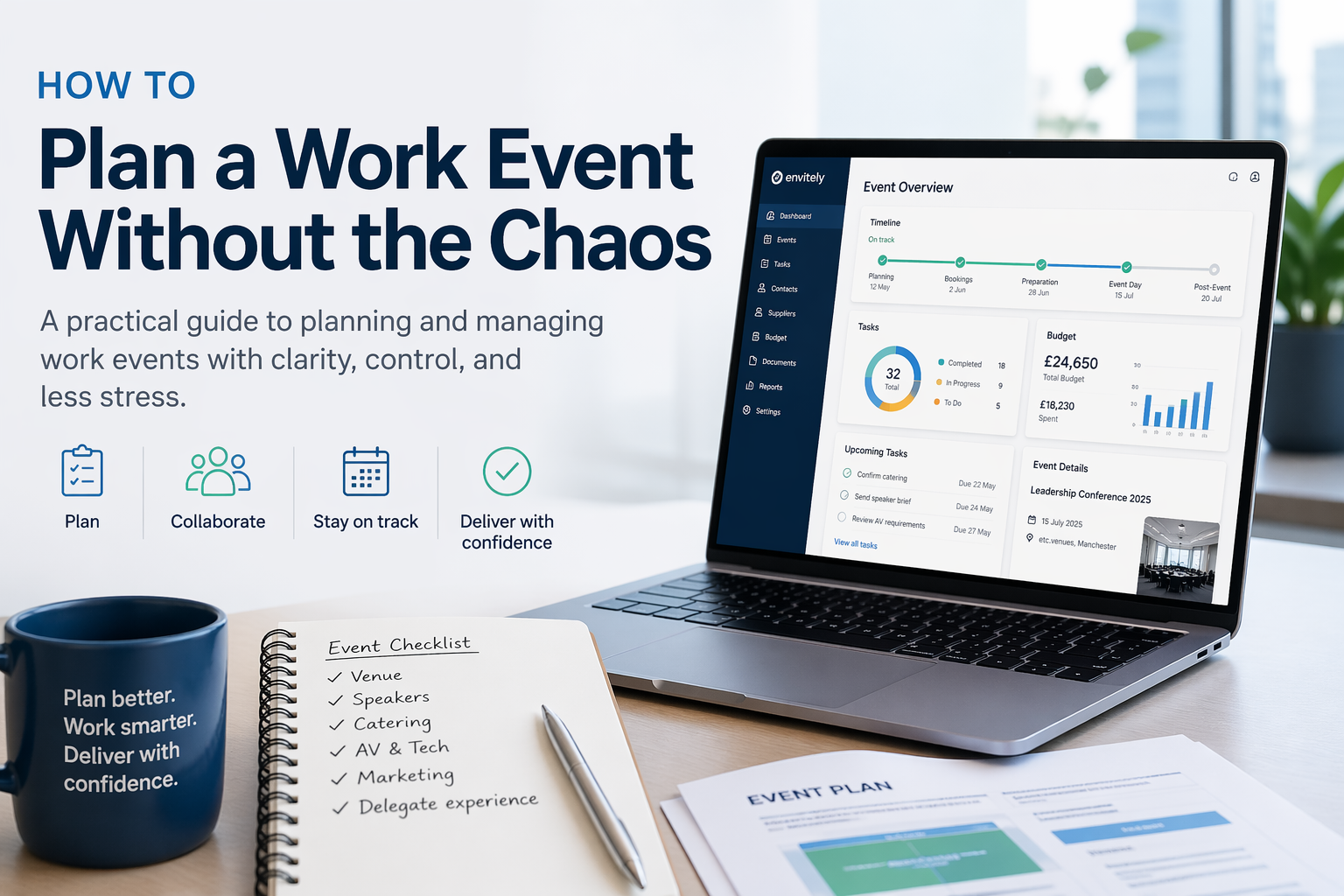

Planning a work event should feel structured and manageable.
In reality, many teams find themselves dealing with scattered information, unclear responsibilities, and constant last-minute pressure. Emails replace systems. Spreadsheets multiply. Updates become difficult to track.
The issue is rarely the event itself. It is how the planning is managed.
This guide outlines a simpler, more reliable approach to planning work events, helping your team save time, reduce friction, and stay in control from start to finish.
Why work event planning often becomes chaotic
Work events bring together multiple elements at once. Teams, suppliers, stakeholders, budgets, approvals, and timelines all need to align.
Without a clear structure, planning becomes fragmented.
Common causes of chaos
Too many disconnected tools
Information is spread across emails, spreadsheets, documents, and messaging platforms. No single source of truth exists.
Unclear ownership of tasks
Actions are discussed but not consistently assigned or tracked.
Manual processes slow everything down
Time is spent chasing updates, confirming decisions, and checking versions.
Lack of visibility for stakeholders
Managers and decision-makers struggle to get a clear view of progress.
Pressure builds late in the process
Small issues go unnoticed until they become urgent.
The result is a planning process that feels reactive rather than controlled.
What effective event planning looks like
A well-managed work event is not defined by complexity. It is defined by clarity.
Teams that deliver consistently successful events tend to follow the same principles:
- All event information is stored in one place
- Responsibilities are clearly assigned
- Progress is visible at all times
- Timelines are structured and realistic
- Communication is consistent and centralised
This creates a planning environment where teams can move forward with confidence.
A step-by-step approach to planning a work event
1. Start with a clear event structure
Before tasks are assigned or suppliers are contacted, define the core structure of the event.
This should include:
- Event objectives
- Key milestones and dates
- Budget parameters
- Stakeholders involved
- Success criteria
Having this in place creates a foundation that guides every decision that follows.
2. Centralise your event information
Avoid managing your event across multiple disconnected tools.
Instead, bring all key information into one place:
- Timelines
- Task lists
- Budgets
- Supplier details
- Documents and notes
This ensures your team always knows where to find the latest information and reduces the risk of errors.
3. Assign clear ownership to every task
Every task should have:
- A named owner
- A defined deadline
- A clear outcome
This removes ambiguity and reduces the need for constant follow-up.
When ownership is visible, accountability improves naturally.
4. Build a structured timeline
Break your event into phases and milestones.
For example:
- Planning and approvals
- Supplier coordination
- Final preparations
- Event delivery
- Post-event follow-up
Mapping dependencies between tasks helps prevent delays and ensures work progresses in the right order.
5. Keep stakeholders informed without extra effort
Stakeholders need visibility, but they should not rely on manual updates.
A structured system allows them to:
- View progress in real time
- Understand risks and blockers
- Access key documents
- Stay aligned without additional meetings
This reduces pressure on the planning team and improves decision-making.
6. Track budgets and suppliers alongside the plan
Financial and supplier management should not sit separately from your event plan.
Track:
- Supplier bookings and contacts
- Costs and approvals
- Payment timelines
This provides better oversight and helps avoid last-minute surprises.
7. Reduce reliance on email
Email is useful for communication, but it is not a planning system.
When key decisions, updates, and documents live in inboxes, information becomes difficult to manage.
Keeping planning activity in a central platform creates a clearer, more reliable process.
How to save time during event planning
Time pressure is one of the most common challenges for corporate and public sector teams.
A more structured approach helps reduce time spent on:
- Searching for information
- Chasing updates
- Rebuilding timelines
- Confirming the latest version of documents
Instead, teams can focus on progressing the event itself.
This is particularly important for organisations managing multiple events or working across departments.
Planning work events at scale
For organisations delivering multiple or recurring events, consistency becomes critical.
A structured planning approach allows teams to:
- Standardise processes across events
- Reuse templates and workflows
- Maintain quality and compliance
- Improve reporting and oversight
This is especially valuable for corporate teams, councils, and public sector bodies where governance and accountability are essential.
A simpler way to stay in control
Planning a work event does not need to involve constant coordination across disconnected tools.
By centralising your approach, assigning clear ownership, and maintaining visibility throughout the process, your team can reduce complexity and deliver events with greater confidence.
The goal is not to change how your team works completely.
It is to give them a clearer, more reliable way to manage what they are already doing.
Why teams use Envitely to plan work events
A clear process makes event planning easier. The right platform makes that process consistent, repeatable, and easier to manage at scale.
Envitely is designed to support the way teams actually plan events, bringing structure, visibility, and control into a single system.
One platform for every type of event
Plan internal meetings, corporate events, public sector programmes, and client-facing experiences using the same structured approach.
This removes the need to adapt different tools for different scenarios and helps teams work more consistently.
A central source of truth
Keep timelines, tasks, budgets, suppliers, and documents in one place.
This ensures everyone is working from the same information and reduces the risk of errors or duplication.
Clear ownership and accountability
Assign tasks with defined deadlines and responsibilities.
This improves coordination across teams and reduces the need for manual follow-up.
Real-time visibility for stakeholders
Give managers and stakeholders a clear view of progress, risks, and upcoming milestones.
This supports better decision-making without requiring additional reporting.
Built to support complex environments
Whether you are managing multiple departments, external partners, or public-facing events, Envitely provides the structure needed to stay in control.
This is particularly valuable for corporate teams, councils, and organisations where oversight and accountability are essential.
Reduces reliance on emails and spreadsheets
Replace fragmented planning methods with a more reliable, centralised workflow.
This saves time, reduces friction, and creates a more dependable planning process.
A practical step towards more organised event delivery
For teams already managing events, the goal is not to change everything.
It is to introduce a clearer, more structured way to manage what is already happening.
Using a platform like Envitely allows teams to move away from reactive planning and towards a more controlled, predictable process, without adding unnecessary complexity.
If you are looking for a more structured way to plan and manage events, you can explore how Envitely supports teams across different types of work events.
Explore the platform
View product features >
Frequently asked questions
What is the best way to organise a work event?
The most effective approach is to centralise all event information, assign clear responsibilities, and track progress through a structured timeline. This reduces confusion and improves control.
How far in advance should you plan a work event?
This depends on the size and complexity of the event. Smaller internal events may require a few weeks, while larger or public-facing events often need several months of planning.
How do you manage multiple stakeholders in event planning?
Clear communication and shared visibility are essential. Using a central system allows stakeholders to access updates, documents, and timelines without relying on manual reporting.
Why do work events become stressful to plan?
Stress often comes from unclear processes, fragmented information, and last-minute changes. A structured approach helps reduce these pressures.
Do I need event planning software for corporate events?
While not always essential, event planning software can significantly improve organisation, visibility, and efficiency, especially for teams managing complex or multiple events.